Big Pot Attachment
When the pot gets big do you find it more difficult to make decisions? In this article we discuss why many poker players get so attached to big pots.
It is simply not enough to study the technical aspects of poker and expect success to fall into your lap. The mental game of poker is an area worthy of equal respect and hard work. In almost every high-level discussion about the game, the inescapable topic of tilt arises, specifically, big pot attachment tilt. Tilt refers to any deviation from a more conscious rational thought process caused by emotional interference.
Big Pot Attachment Tilt occurs when this deviation takes place in a large pot, driven by the human instinct to not surrender anything into which resources, time and energy have been invested. Your mental game journey is fundamentally a battle between how you would like to be and how you are. Letting go of big pots when your conscious mind knows the time to be right is a battle within that battle. This is the poker version of the Sunk Cost Fallacy. Your brain tries to tell you that the chips already in the pot are still ‘yours,’ and it will invent any excuse to keep you from ‘losing’ them.

A Case Study Hand
To see how this plays out in practice, let’s look at a common – and costly – scenario:
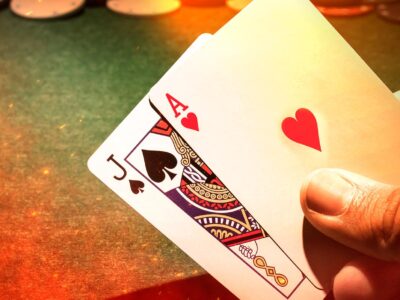
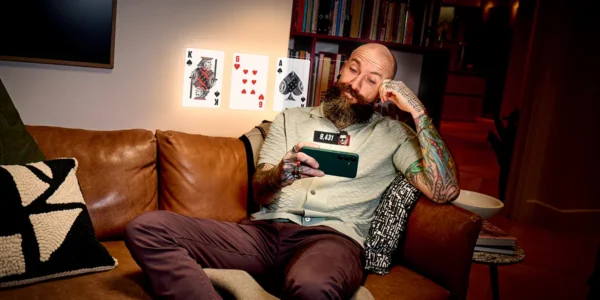
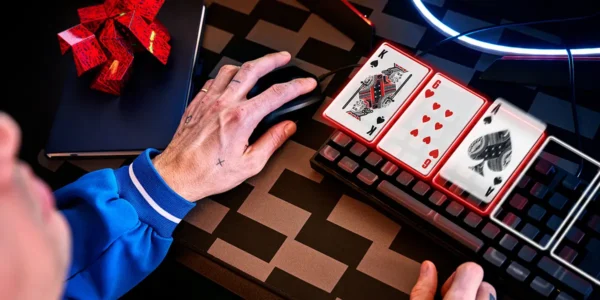
Hero 3-Bets A♥K♣ in a 6-handed cash game from the SB (small-blind) and the CO (cut-off) opener calls. They go heads-up to a flop of K♦10♥5♥ and Hero bets half of the pot. Villain makes the call in position and the turn brings the 7♠. Hero makes another very reasonable value bet and is called once again. The river brings the J♣ and the pot is now very large. In fact, the remaining effective stack is just a three-quarter pot-sized bet.
Let’s look at this hand from an objective and detached viewpoint before you put yourself in the mind of Hero during the heat of battle. There are three options that must be considered in this spot before you can come to a decision. The EV of each of them must be weighed up and compared. The three options are bet all-in, check/call, and check/fold.
Let’s start with the first one.
Before you can decide to bet you must be clear on the purpose of that bet. All good bets will gain a sufficient amount of either value (getting called by a range they are ahead of), bluffing EV (getting fold equity from a sufficient amount of better hands), or protection (getting a large chunk of worse hands that have live outs to fold.)
Clearly a river bet can never be for protection as there are no more cards to come and all equity is fully realised already. Bluffing with this hand also seems silly as to expect the CO to fold two-pair or better is unrealistic with less than a pot-sized bet remaining. Could this be a value bet then? It would seem not. In order to get called by worse, Villain would need to be paying off with not just KQ, but also a fair few weaker hands like second pair. Without the read that he is very sticky, this is also overly optimistic.
Betting is out – there is simply no reason for it!
Check/calling is perhaps even worse against a typical micro-low stakes opponent. Check/call is a line that seeks to make money from bluffs as no worse hand is ever realistically value betting this river in Villain’s shoes. What bluffs are you likely to see here? Well, having the A♥ dramatically reduces the combinations of Villain’s busted flush draws, making A♥4♥ and the like impossible. In order to be bluffing on such a high run-out that connects so well with both players’ ranges, Villain needs to be getting creative and turning holdings like T9, QT and QJ into a bluff.
While this is precisely what he should do in theory since these hands have pitiful show-down value, most players at lower stakes like 25NL are not making these bluff shoves. Check/calling then is a good way to burn off the rest of your stack and is also out.
There you have it. There is one option remaining. Hero must check/fold this river. It is not that he is always losing the pot as very often the river will check through and your king will be good enough to beat a lower pair that would not have paid off a bet anyway. If Villain does bet, his range is likely to be significantly underbluffing, meaning that he does not use enough hands in his range as bluffs. The Hero shoves the river, only to be snapped off by K♠J♠.
What Went Wrong?
When you find yourself in this spot, it often sounds like this:
What Your Mind Tells You in Big Pots:
“ There’s no way I’m folding this river and I think betting is better than check/calling
Why was there such a strong revulsion towards the idea of giving up on this pot? Folding hurts because you’re already pot-committed emotionally. You’ve invested too much effort to just walk away with nothing. Your subconscious mind was so mercilessly possessed by the compulsion to not let go of resources that you were unwilling to even entertain the idea of check/folding for a split second.
This happens due to your evolutionary history and how disastrous it would be for your survival prospects if you were to constantly put effort, money and time into something only to reap nothing at the end of the process. A species that got kicks out of such an action would die off quite quickly. The real challenge for the poker player is to rewire his or her brain in this new environment where it is actually paramount to your survival to let go of big pots that no longer deserve any further investment.
The Fix
The games have changed, and some players today are more capable of applying pressure in big pots. But that does not mean every scary river bet is a bluff. The skill is not to become stubborn in either direction, but to stay detached enough to judge the actual range in front of you.
So how do you go about achieving this rewiring of such a strong human impulse? You practice it in-game in the very situations in which you feel the tilt affecting you. In-game rewiring is essential as what you are trying to break is not a conscious misunderstanding, but a sub-conscious habit. Next time that you are in a large pot and suspect that you might do best by folding, try to see the compulsive feeling that you must not let go of this pot for what it is – a misfiring animalistic urge.
Once you see that the bet and call buttons are only appealing to an irrational part of your mind that does not understand poker, you can see how silly it would be to press either of them. Try saying something snappy and powerful to yourself such as:
What to Tell Yourself in Big Pots:
“ I will listen to logic, not impulse
“ Desires have no place at the poker table
“ To call this bet is to give in to my emotions
Eventually, the subconscious mind will learn that these pots are not the time nor place for the resource protection instinct and will stop constantly pressuring you to make bad investments.
How to spot the tilt before you click ‘Call’:
- You’re praying for a check-around because you know you can’t beat a bet.
- You feel “insulted” that they are trying to take “your” pot.
- You’ve stopped thinking about their range and started thinking about your session graph.
- You are looking for reasons to continue instead of reasons that are actually true.
Conclusion
Big pots are difficult things to process. Your level of emotional interference is at its highest and only through time and hard-work can you come to control the impulses that cause all of those needless extra losses. Next time that you are raised on the river or face a terrible card for your hand and a big bet from your opponent, try to pay attention to how much of your thought process is rational and clear, and how much is just a brute-force desire to hold on to your precious resources (chips).
View Other Blogs